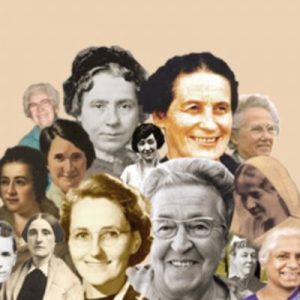
Frances Ridley Havergal
FRANCES RIDLEY HAVERGAL, THE CONSECRATION POET
The beauty of a consecrated Christian life has probably never been more perfectly revealed than in the life of Frances Ridley Havergal. To read the story of her life is not only an inspiration, but it discloses at once the secret of her beautiful hymns. She lived her hymns before she wrote them.
This sweetest of all English singers was born at Astley, Worcestershire, December 14, 1836. She was such a bright, happy and vivacious child that her father, who was a minister of the Church of England and himself a hymn-writer of no mean ability, called her “Little Quicksilver.” Her father was also a gifted musician, and this quality too was inherited by the daughter, who became a brilliant pianist and passionately fond of singing. However, because she looked upon her talents as gifts from God to be used only in His service, she would sing nothing but sacred songs.
Her sunshiny nature became even more radiant following a deep religious experience at the age of fourteen. Of this she afterwards wrote:
“I committed my soul to the Saviour, and earth and heaven seemed brighter from that moment.”
At the age of eighteen she was confirmed. It is evident that she looked upon her confirmation as one of the most blessed experiences of her life, for when she returned home she wrote in her manuscript book of poems:
“THINE FOR EVER”
| Oh! Thine for ever, what a blessed thingTo be for ever His who died for me!My Saviour, all my life Thy praise I’ll sing,Nor cease my song throughout eternity. |
She also wrote a hymn on Confirmation, “In full and glad surrender.” This hymn her sister declared was “the epitome of her life and the focus of its sunshine.”
Four years later, while pursuing studies in Düsseldorf, Germany, Miss Havergal chanced to see Sternberg’s celebrated painting, Ecce Homo, with the inscription beneath it:
| This have I done for thee;What hast thou done for me? |
This was the same painting that once made such a profound impression on the youthful mind of Count Zinzendorf. Miss Havergal was likewise deeply moved, and immediately she seized a piece of scrap paper and a pencil and wrote the famous hymn:
I gave My life for thee,
|
She thought the verses so poor after she had read them over that she tossed them into a stove. The piece of paper, however, fell out untouched by the flames. When she showed the words to her father a few months later, he was so touched by them he immediately composed a tune by which they could be sung.
This seems to have been one of the great turning points in the life of the young hymnist. Her hymns from this period reveal her as a fully surrendered soul, her one ambition 329being to devote all her talents to Christ. She did not consider herself to be a poet of a high order, but so filled was she with the love of Christ that her heart overflowed with rapturous praise. Indeed, her hymns may be said to be the record of her own spiritual experiences. Always she was proclaiming the evangel of full and free salvation through Jesus’ merits to all who believe.
She is often referred to as “the consecration poet.” This is an allusion to her famous consecration hymn, written in 1874:
| Take my life, and let it beConsecrated, Lord, to Thee.Take my moments and my days;Let them flow in ceaseless praise. |
The circumstances that led to the writing of this hymn are interesting. Miss Havergal was spending a few days in a home where there were ten persons, some of them unconverted, and the others rather half-hearted Christians who seemed to derive no joy from their religion. A great desire came upon her that she might be instrumental in bringing them all to true faith in Christ. Her prayer was wonderfully answered, and on the last night of her stay her heart was so filled with joy and gratitude she could not sleep. Instead, she spent the night writing the consecration hymn.
Her prayer, “Take my silver and my gold; not a mite would I withhold,” was not an idle petition with her. In August, 1878, she wrote to a friend: “The Lord has shown me another little step, and of course I have taken it, with extreme delight. ‘Take my silver and my gold,’ now means shipping off all my ornaments to the Church Missionary House (including a jewel cabinet that is really fit for a countess), where all will be accepted and disposed of for me. 330I retain a brooch or two for daily wear, which are memorials of my dear parents, also a locket containing a portrait of my dear niece in heaven, my Evelyn, and her two rings; but these I redeem, so that the whole value goes to the Church Missionary Society. Nearly fifty articles are being packed up. I don’t think I ever packed a box with such pleasure.”
In addition to her other accomplishments, Miss Havergal was a brilliant linguist, having mastered a number of modern languages. She was also proficient in Greek and Hebrew. Her sister records that she always had her Hebrew Bible and Greek New Testament at hand when she read the Scriptures.
The study of the Bible was one of her chief joys. During summer she began her Bible reading at seven in the morning, and in winter at eight o’clock. When, on cold days, her sister would beg her to sit near the fire, she would answer: “But then, Marie, I can’t rule my lines neatly. Just see what a find I’ve got. If one only searches, there are such extraordinary things in the Bible!” Her Bible was freely underscored and filled with notations. She was able to repeat from memory the four Gospels, the Epistles, Revelation and all the Psalms, and in later years she added Isaiah and the Minor Prophets to the list.
Miss Havergal was only forty-two at the time of her death, on June 3, 1879. When her attending physician told her that her condition was serious, she replied, “If I am really going, it is too good to be true!” At the bottom of her bed she had her favorite text placed where she could see it: “The blood of Jesus Christ His Son cleanseth us from all sin.” She also asked that these words be inscribed upon her coffin and on her tombstone. Once she exclaimed: “Splendid! To be so near the gates of heaven!” And again, 331“So beautiful to go! So beautiful to go!” She died while singing:
Jesus, I will trust Thee,
|
Some of the more popular hymns by Miss Havergal, aside from those already mentioned, are: “O Saviour, precious Saviour,” “I am trusting Thee, Lord Jesus,” “Thou art coming, O my Saviour,” “Lord, speak to me, that I may speak,” and “Singing for Jesus, our Saviour and King.” While she was writing the hymns that were destined to make her famous, another remarkable young woman, “Fanny” Crosby, America’s blind hymn-writer, was also achieving renown by her hymns and songs. Miss Havergal and Miss Crosby never met, but each was an ardent admirer of the other, and on one occasion the English poet sent a very touching greeting to the American hymn-writer. It read:
Dear blind sister over the sea,
|
From Story of Our Hymns
Books:
The Ministry of Song, 1870
Under the Surface, 1874
Kept For The Master’s Use, 1879
Life Chords, 1880
Under his shadow : the last poems of Frances Ridley Havergal (1880)
The Poetical Works of Frances Ridley Havergal
Memorials of Frances Ridley Havergal by Her Sister, Maria Vernon Graham Havergal
Letters by the Late Frances Ridley Havergal, Compiled by Her Sister, Maria Vernon Graham Havergal
- ‘The Things Which are Behind’ by Francis R. Havergal
- Am I Hindering Anyone? By Frances Ridley Havergal
- Another Year For Thee by Frances Ridley Havergal
- Another Year Is Dawning By Frances Ridley Havergal
- Be Not Weary by Frances Ridley Havergal
- Biography of FRANCES RIDLEY HAVERGAL
- Divine Tenderness by Frances Ridley Havergal
- God The Provider by Francis R. Havergal
- Going Forth With The King By Frances Ridley Havergal
- He Is Thy Life by Francis R. Havergal
- I Am Trusting Thee, Lord Jesus by Frances Ridley Havergal (Hymn story)
- Just When Thou Wilt by Francis R. Havergal
- Like A River Glorious by Francis R. Havergal
- Live Out Thy Life Within Me by Francis R. Havergal
- Lord, speak to me, that I may speak… by Francis Ridley Havergal
- On What Do You Feast Your Mind? By Frances Ridley Havergal
- Privilege of Intercessory Prayer by Frances Ridley Havergal
- Separation Unto By Frances Ridley Havergal
- Set Apart by Francis R. Havergal
- Shine ’Mid The Darkness By Frances Ridley Havergal
- Take My Life and Let It Be by Frances Ridley Havergal
- The Secret of a Happy Day by Francis R. Havergal
- The Sure Afterward by Frances Ridley Havergal
- The Unfailing One by Francis R. Havergal
- Truehearted, wholehearted by Francis R. Havergal
- Who is on the Lord’s side? by Francis R. Havergal
- Whose I Am by Frances Ridley Havergal
- Zeal – Faith – Fervor! By Frances Ridley Havergal

Hi, I would like to know the story behind the song “Live out thy life within me”, that why did she writte it? What was the motive if you do have some information about this.
Thank you.
Hi, Brother/sister, I do not know. I did try to look it up, but could not find it. The date that it was actually written is not even available. So information about this hymn seems to be unknown for the most part. However, I may try to look into it and other hymns some more. I am glad you brought it up. It is a wonderful piece. Thanks. Your sister in Christ, Michelle
Hi – I wonder if you might pass this listing onto any who might be interested in Havergal’s works. This is a rare 1st edition copy of Frances Ridley Havergal’s “Under the Surface”, 1834. It is in extraordinarily pristine shape. Thanks for your help.
http://www.ebay.com/itm/Under-Surface-Frances-Ridley-Havergal-1834-J-Nisbet-Co-/180772247730?pt=Antiquarian_Collectible&hash=item2a16dd98b2
Liz
I do not really advocate spending that much money on books… :)
I did find a place where you can read this book online or download it as an ebook for free. There are some good poems/hymns in this book. http://books.google.com/books/about/Under_the_surface.html?id=93AkAAAAMAAJ